
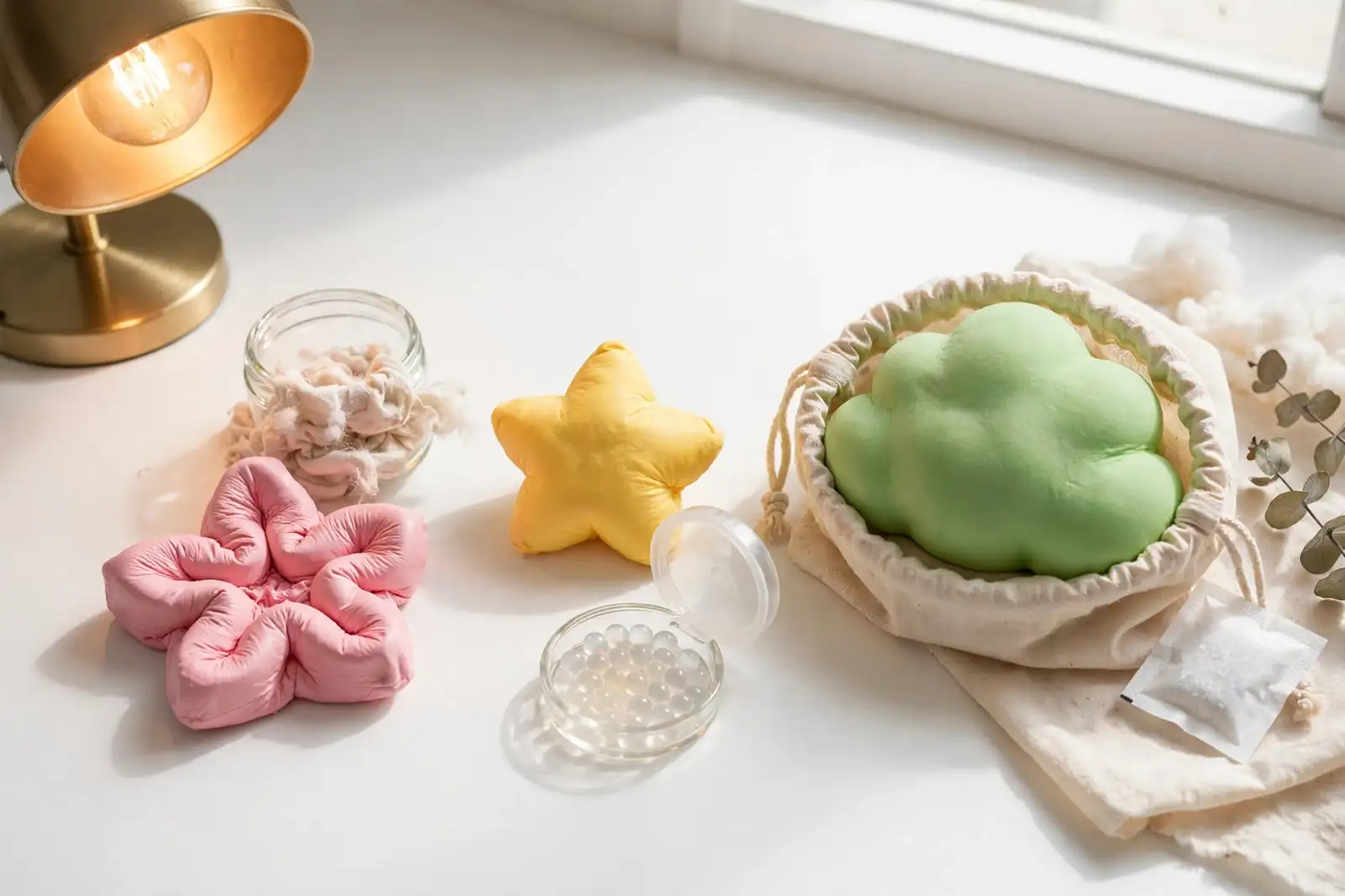
Why Your Squishy Loses Its Shape Fast and How to Prevent It
Published on 9 min readSquishiesCompare AI models
Your squishy loses its shape fast for three reasons: the low-density foam used in many cheap toys has internal walls that break easily, air moisture penetrates the foam making it heavy and slow, and storing it squished in a backpack creates permanent marks. You can double the toy's lifespan by choosing quality materials and changing how you store it — these are simple habits that start making a difference the same day.
Why does squishy foam deform over time?
Polyurethane foam is the most common material in both homemade and industrial squishies. Deformation happens when the internal air bubbles of the foam collapse under repeated pressure. A low-density foam (below 25 kg/m3) has thin walls between the bubbles. Each squeeze breaks some of those walls. Over time, the foam loses its ability to return to its original shape. It's like squishing a loaf of bread every day — eventually, it won't rise back.
Another factor is the quality of the polyurethane. Foams from generic brands or very cheap toys often contain additives that speed up degradation. If you make squishies at home, choose high-density polyurethane foam (above 30 kg/m3) sold at craft or upholstery stores. It costs a bit more, but the lifespan doubles. In practice, high-density foam rarely reaches regular toy stores — you need to look in specialty shops.
How do humidity and heat affect squishy shape?
Humidity is the biggest enemy of squishies. When the air is humid (above 70%), the foam absorbs water. Water takes the place of air inside the bubbles. The foam becomes heavier and less elastic — the result is a squishy that returns slowly and, after drying, shrinks or gets wrinkled. To dive deeper into this point, see Why Your Homemade Squishy Gets Hard or Rubbery? Causes and.
Heat also causes damage. Above 40 °C (104 °F), polyurethane softens and can deform permanently if pressed. Leaving your squishy in a closed car in summer or near a window that gets afternoon sun is a sure way to lose its shape. The ideal is to keep it at room temperature (20–25 °C / 68–77 °F) and away from heat sources. A common mistake is storing the whole collection in an attic or garage, precisely where temperature and humidity vary the most.
What is the correct way to store squishies?
Storing squishies stacked or squeezed inside a drawer is the most common mistake. The constant pressure of one squishy on another deforms the foam at specific points, creating that dent that won't go away. The solution is to store each squishy separately, preferably inside an airtight container with a lid. The container keeps out dust and regulates the humidity around the toy.
If you have several squishies, use organizer boxes with dividers. Another option is to put each one in a breathable fabric bag (cotton or non-woven) before stacking. For squishies you rarely use, the fridge helps. The cold (between 4 and 8 °C / 39–46 °F) keeps the foam firm and slows degradation. But be careful: never freeze, because ice ruptures the internal bubbles.
How to fix a squishy that has already lost its shape?
If your squishy is already deformed, all is not lost. The simplest method is to apply moderate heat with a hair dryer on medium power, 6 inches (15 cm) away, for 10 to 15 seconds. The heat reheats the polyurethane and allows it to settle back. While the foam is warm, mold the squishy with your hands into its original shape and let it cool on a flat surface.

Another technique is washing with cold water and mild soap. The water removes excess dirt and skin oils that may be making the foam stiffer. After washing, squeeze the squishy in a towel to remove excess water and let it dry in the shade for 24 hours. Do not use a dryer or direct sunlight — strong heat damages the foam.
For squishies with silicone filling (the ones with a more liquid texture inside), repair is harder. If the silicone has leaked or the casing has ruptured, the best option is to replace the filling. You can find refill kits at craft stores or reuse silicone from an old toy.
What mistakes speed up squishy deformation?
Squeezing with maximum force every time you use it — Squishies are not stress balls that require full force. The correct motion is a gentle, gradual squeeze. Squeezing with maximum force ruptures the internal foam walls faster. Prefer to squeeze slowly and feel the texture; the squishy returns faster and lasts longer.
Storing inside a backpack or bag without protection — The backpack presses the squishy against hard objects, like a notebook, creating point pressure that deforms the foam faster than a uniform surface. In one hour of transport, constant pressure already starts to create a dent. If you take your squishy out, put it inside a rigid glasses case or a small acrylic box.
Using low-quality acrylic paint on the surface — Paints that are too thick or contain harsh solvents dry out the foam surface. The paint layer forms a crust that prevents the foam from expanding freely. For homemade squishies, use acrylic paint made for fabric or foam, diluted with a little water (ratio 3 parts paint to 1 part water). I prefer this diluted paint because it creates a flexible film that doesn't crack.
Which material lasts longer: polyurethane foam or silicone?
| Feature | Polyurethane foam (high density) | Silicone filling |
|---|---|---|
| Durability | 6–12 months with basic care | 3–6 months (leaks more easily) |
| Moisture resistance | Low — absorbs water | High — waterproof |
| Ease of repair | High — heat and washing work | Low — needs filling replacement |
| Cost | Medium ($3–6 per block) | Low ($1–2 per tube) |
| Squeeze feel | Firm and slow (slow rising) | Liquid and very soft |
For those who want a squishy that lasts longer, high-density polyurethane foam is the best choice. Silicone is cheaper and gives a nice texture, but requires extra care with storage — it leaks easily if the casing is accidentally punctured.
How to make a homemade squishy that doesn't deform easily?
- Choose the right foam — Buy a block of polyurethane foam with a density between 30 and 35 kg/m3. At upholstery stores, ask for "D33 foam" or "foam for children's mattresses." Cut it into the desired shape with a utility knife.
- Seal the surface — Apply a thin layer of white school glue diluted in water (1:1) over the entire foam surface. This creates a film that reduces moisture absorption. Let it dry for 2 hours.
- Paint with diluted acrylic paint — Use acrylic paint made for fabric, diluted in a 3:1 ratio (paint:water). Apply with a soft brush in thin layers. Wait 30 minutes for each layer to dry before the next.
- Finish with spray varnish — A matte acrylic spray varnish (found at stationery stores) protects the paint and seals the foam. Apply 8 inches (20 cm) away, in a well-ventilated area. One coat is enough.
- Cure the squishy — After finishing, let the squishy rest on a flat surface for 24 hours before using. This time allows the glue and paint to dry completely and the foam to stabilize.

If you want a more detailed guide with foam types, paint brands, and painting techniques for beginners, the ebook Squishy Made at Home — The Complete Guide to Creating Your Own Squishies shows each step with photos and a materials list. It's the next step after mastering the basics.
How does usage affect squishy lifespan?
Beyond storage and material, the way you interact with your squishy daily determines how long it keeps its original shape. Each squeeze, squish, or stretch causes micro-damage to the foam or silicone structure. Over time, these damages accumulate and speed up shape loss.

Why does squeezing the same spot wear it out faster?
If you have the habit of squeezing your squishy in the same place every time — like the center or a specific edge — that area suffers excessive compression. Polyurethane foam, for example, has cells that rupture when pressed too much in one spot. To avoid this, vary the pressure points: squeeze different areas each time you use it. If the squishy is shaped like an animal, don't focus only on the head; use the body too.
Does squeeze speed make a difference?
Squeezing the squishy very fast and with full force causes the internal air to be expelled abruptly, and the foam doesn't have time to reorganize. This permanently deforms the cell walls. The ideal is to squeeze slowly, feeling the resistance, and release gradually as well. Smooth, controlled movements preserve the structure longer.
Can I twist or stretch my squishy?
Twisting the squishy or stretching it beyond the foam's natural limit is one of the most common causes of rapid deformation. This type of movement ruptures the internal bonds of the material, creating flabby areas that don't return to normal. Avoid games that require twisting, and never pull the ends with force.
How often can I use the same squishy?
A squishy used several times a day, every day, will wear out faster than one used occasionally. If you have a favorite squishy, try alternating with others in your collection to give it recovery time. The foam needs hours (or even days) to regain its shape after intense squeezing.
The next concrete step is to take your most-used squishy right now and inspect it. Does it have a permanent dent? Try the hair dryer technique if so. Then, find an airtight container or a small box to store it — that single care habit extends durability the most.
*This text is for informational purposes only and does not replace professional guidance. Every squishy is unique; observe its behavior and adapt care accordingly.*
Read also
- How to Avoid Buying from Unreliable Suppliers When Importing
- How Long Does It Take to Form a New Habit? Find Out Now!
Frequently asked questions
Can I use old pillow foam to make a squishy?
It depends on the foam density of the pillow. Memory foam pillows have a density between 40 and 60 kg/m³, which is excellent for squishies. But low-density regular foam pillows (below 20 kg/m³) deform quickly. Test by squeezing a corner: if the foam takes more than 5 seconds to fully bounce back, it's suitable.
What to do when the squishy starts shedding foam pieces?
This means the foam is disintegrating from the inside, usually due to moisture or old age (over 1 year). There's no fix—the foam has lost its internal structure. The best is to replace the foam block with a new high-density one. To prevent this from happening again, never wet the squishy and keep it in an airtight container.
Can squishies go in the washing machine?
No. The washing machine crushes, twists, and exposes the squishy to heat and spinning, which permanently damages the foam. If you need to clean it, hand wash with cold water and mild soap, gently squeezing. Then dry in the shade on a towel for 24 hours.
How long does a well-maintained homemade squishy last?
With high-density foam (above 30 kg/m³), storage in an airtight container, and moderate use (squeezing about 10 times a day), a homemade squishy lasts from 6 to 12 months. Silicone squishies last less, around 3 to 6 months, because silicone tends to leak over time. The main difference lies in foam density and protection against moisture.