
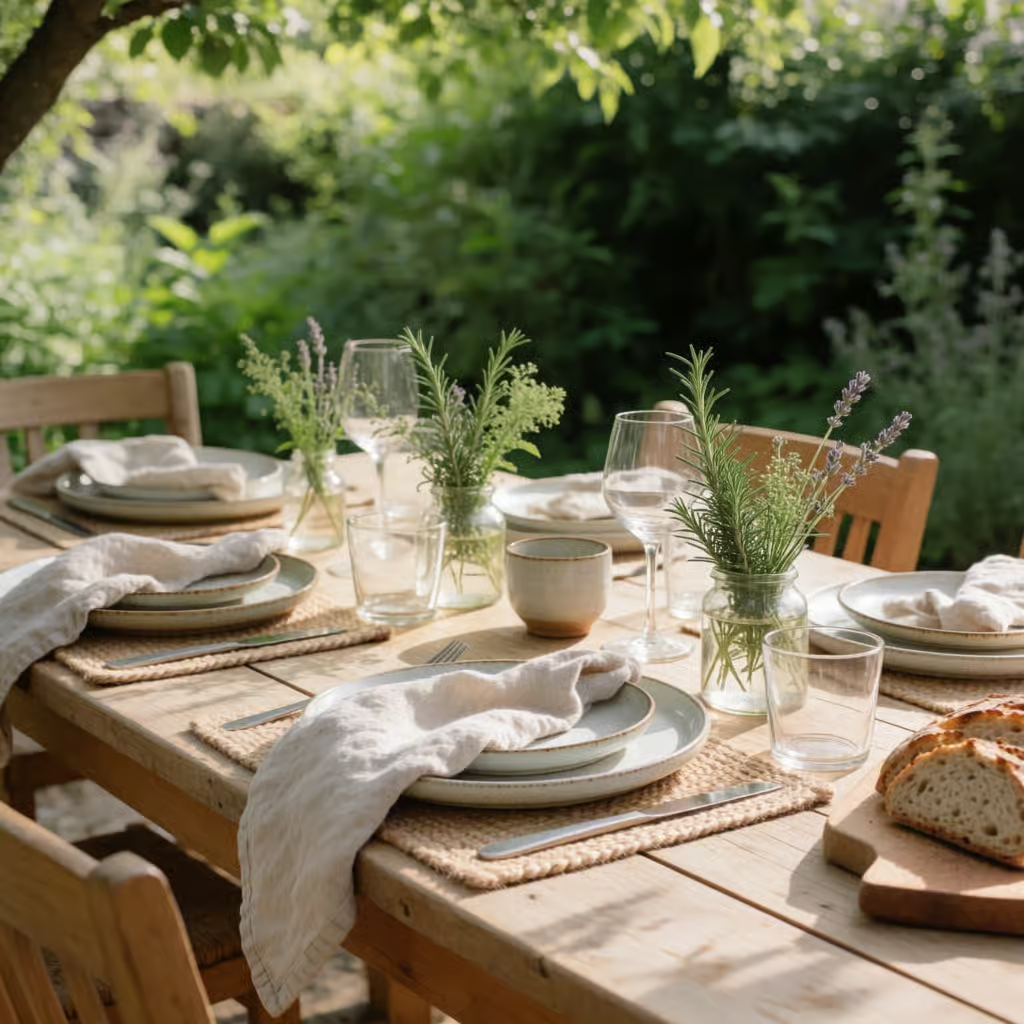
Natural Centerpieces: Transform Any Space with What You Already Have
Published on 13 min readTable SettingCompare AI models
You can create an elegant, decorated centerpiece in half an hour using only what you already have at home or in your yard. Just focus on natural elements like leaves, stones, or branches that complement the main dish of the meal. This approach works especially well for beginners because it eliminates the need to buy specific items, and the result is authentic and personal. The only condition is to choose elements that won't stain the dishes or take up too much space for guests.
How to Choose Natural Elements for Your Centerpiece Without Spending Money
Natural elements for centerpieces are any materials from nature, such as leaves, wildflowers, stones, or branches, used for decoration. You don't need to buy anything—just take a walk in your yard or a nearby park to find options. Harvesting is the easiest part, but it requires care to avoid toxic plants or those that release sap. For more on this, see How to Create Effective Rules to Limit Kids' Screen Time.
I prefer using eucalyptus leaves. They have a green color that matches almost everything, and in my experience, they stay fresh for up to five days if stored in a well-ventilated area. Another advantage is that the eucalyptus scent is mild and helps repel insects.
A practical example is using border leaves for an autumn centerpiece. The red and gold colors create a cozy tone. You can place a single leaf on each plate. If the leaves are very dry and brittle, submerge them in cold water for ten minutes before drying with a cloth—they become more flexible.
Another idea is using polished stones as napkin weights. You can find these stones in streams or at the beach; just wash them and dry thoroughly. River stones are better because their edges are naturally rounded and won't scratch the table surface.
Avoid elements that might stain dishes. Overripe fruits that release juice are a risk—if you don't test them first, you'll only notice the problem when the centerpiece is already set up. Testing is easy: place the element on a white ceramic plate for fifteen minutes and check if it leaves a mark.
It's also best to avoid spiny items like wild roses, which could hurt your guests. There are many beautiful, thornless flowers around, such as daisies or field flowers. If you're not sure, run your finger along the stem to feel for thorns.
Always test elements before placing them in the final setup. Put the leaf or stone on an empty plate and check if it leaves residue. If it stains, discard it. A trick for leaves is to wipe them with a damp cloth and then press against a white napkin—if color comes off, it will stain.
To harvest from your own yard, choose healthy plants with no signs of pests. Take a close look at each branch. Leaves with brown tips or holes usually harbor insects you don't want on your centerpiece.
If you're going to a park, check local rules first. Some places prohibit picking plants and flowers, so it's best to respect the regulations. Often, you can collect materials that have already fallen to the ground, like pinecones or dry branches, without breaking any rules.
How to Arrange a Centerpiece Using Household Items for Beginners
A centerpiece using household items simply means using objects you already have—plates, utensils, napkins, pots—to create your decoration. You don't need special occasion utensils; everyday items work perfectly. The secret is in the arrangement and small details that transform the ordinary into something special. To go deeper on this point, see Why Napkins Transform Every Meal.

An important point is to arrange utensils in the order of use. The dinner fork and knife go to the right of the plate. The dessert spoon goes to the left. If you're confused, remember this rule: arrange utensils from the outside in, according to the order of the plates to be served. For a simple meal with appetizer, main course, and dessert, you'll have three utensils on each side.
Use the cloth napkins you already have. Fold them into a cone shape and place a small fruit, like a grape or a blueberry, inside. It becomes a natural, charming detail. If you don't have cloth napkins, paper ones work—fold them into a rectangle and tie with a ribbon, placing a sprig of herb under the knot.
Empty glass jars turn into instant vases. Just place a handful of wildflowers inside. Using jars of different sizes creates a more interesting visual composition. To stabilize the stems, fill the bottom of the jar with aquarium pebbles or small stones before adding water.
For the tablecloth, choose one you already have that harmonizes with the natural elements. If you're using green leaves, a white or neutral tablecloth creates a good contrast and makes the decoration stand out. If the tablecloth has a very strong print, flip it to the reverse side—the smooth side is usually more suitable for a natural centerpiece.
Plates should also be the ones you normally use. Opt for solid colors or simple patterns, as highly detailed plates can compete with the simplicity of natural elements. White or light-colored plates are the safest choice, as they highlight any element you place on them.
When setting the plates, leave enough space between them. A distance of at least 30 centimeters ensures each guest has room to rest their arms and utensils without bumping into neighbors. You can use a ruler to check, but just by eye, you can get a good sense. A tip is to place the plate and then try to rest both elbows on the table next to it—if it doesn't touch anything, the space is good.
How to Fix the Common Mistake of Overdoing Natural Decorations
The most common mistake is filling the table with decorations, leaving it cluttered and with no practical space for plates and cups. A clear sign is when guests have to push objects to the side to sit down. The fix is simple: use at most three natural elements per guest area, or even better, just one per plate. Simplicity is what makes natural decorations elegant.
You'll know you overdid it when you see people rearranging the table. In that case, just remove a few items. Leave only the essentials—a beautiful leaf on the napkin already makes an impact. Often, fewer elements allow each one to stand out more.
For example, placing a leaf, a flower, and a stone around each plate is overkill. Try leaving just the leaf. The natural touch is evident without the cluttered look. If you want variety, use one type of element per area—leaves in the center of the table, stones on the napkins.
Test the arrangement before the party starts. Sit in each place at the table and check if the view is good and if there's comfortable space for your arms. If any element is blocking conversation between guests, remove it. A tall vase in the center, for example, can block the view of someone sitting on the other side.
If during the meal you notice something is bothering you, you can adjust it on the spot. Removing a small vase from the center of the table or some stones from the sides won't ruin the decoration—on the contrary, your guests will appreciate the extra space. The decoration should serve the experience, not the other way around.
To avoid the problem from the start, make a small sketch of the table. Draw where the plates will go and where you plan to place each decoration. This helps visualize if the setup is balanced or overloaded. Another technique is to set up a single complete place (with plate, utensils, and decoration) and then replicate it—this ensures consistency without overdoing it.
Step-by-Step to Create a Natural Centerpiece in 30 Minutes
This section is an ordered list with steps, each including a detail beginners often make.
- Choose natural elements (beginners make the mistake of choosing staining elements)
Select items that don't release sap or juice. Test by placing the leaf or fruit on an empty plate for a few minutes. If it leaves a mark, don't use it. Eucalyptus leaves and polished stones are safe options. Avoid cut citrus fruits like lemon, as the acid can damage some types of dishes.
- Clean the natural elements (beginners make the mistake of not washing the leaves)
Wash everything in cold water to remove dust and possible insects. Dry with a clean cloth or let it air dry. This prevents dirt from falling onto the dishes or food. For more delicate flowers, a gentle spray of water is enough—don't soak them.
- Arrange the plates on the table (beginners make the mistake of placing plates too close)
Position each main plate at least 30 cm away from the next. This ensures space for guests. If you don't have a ruler, use your open palm as a reference—about two palm widths. Align the plates with the table edges to create a visual order.
- Place the utensils in the order of use (beginners make the mistake of placing utensils in the wrong order)
Arrange utensils from the outside in, following the meal sequence. Dinner knife and fork are farther from the plate; the dessert spoon is closer, above the plate or to the left. The knife blades should face the plate.
- Add the natural decorations (beginners make the mistake of placing too many decorations)
Start with little. A leaf on the plate or a small branch between two places is enough. Less is more—the idea is to complement, not dominate the table. If using vases, place them at the intersections between places, not directly in front of someone.
- Test the arrangement (beginners make the mistake of not testing the arrangement)
Sit in each chair as if you were a guest. Check if you can see the people in front of you without obstacles and if you have space to rest your arms. Adjust the position of decorative items if needed. Also, check if the elements aren't shedding petals or leaves onto the plates.
*The above text is for informational purposes. For detailed etiquette advice, consult a professional.*
Comparison Between Natural and Artificial Decorations for Centerpieces
This section is a markdown table with two options and more than one criterion.
| Criterion | Natural Decorations | Artificial Decorations |
|---|---|---|
| Cost | Zero (if using what you have) | High (if buying) |
| Durability | Short (up to 5 days) | Long (years) |
| Ease of maintenance | Easy (just wash) | Hard (just wipe with a cloth) |
| Environmental impact | Low (biodegradable) | High (plastic) |
| Personalization | High (unique per harvest) | Low (standardized) |
| Preparation | Requires harvesting and cleaning | Ready to use |
Personally, I prefer natural decorations. They're affordable, have a lower environmental impact, and bring a unique, seasonal touch to the centerpiece. You can easily adapt them for each occasion. The limitation of short durability forces me to be creative each time, which avoids monotony.
Artificial decorations make sense if you need something that lasts for many years or for permanent decoration. The downside is the initial cost and the fact that they're often made of materials that aren't always recyclable. Also, they accumulate dust in a way that's hard to clean completely.
You can combine the two worlds. For example, a ceramic vase (artificial) with wildflowers picked from the garden lasts the entire event without needing care. Just test the combination beforehand to see if the look is harmonious. Avoid mixing too many materials—choose one artificial base element (like the vase) and complement it with nature.
How to Adapt a Natural Centerpiece for Different Occasions
A natural centerpiece adapted for different occasions means adjusting the natural elements according to the event. For a breakfast, use mint or parsley sprigs, which not only decorate but also perfume the room. For a more formal dinner, dry, elegant branches or large leaves create a sophisticated base. The key is to think about the color palette and texture that match the celebration's vibe.
For a children's birthday, painted pinecones with non-toxic paint or colored leaves with wax string are a safe, fun option. For a romantic dinner, rose petals (without thorns) scattered lightly over the tablecloth create the mood. The rule is to maintain functionality—nothing a child could swallow or that slips under the plates.
At Christmas, pine branches, cinnamon sticks, and star anise form a thematic, aromatic decoration. In summer, seashells, dried starfish, and palm leaves bring the beach to the table. Remember that highly seasonal elements like pinecones can be stored from one year to the next if they're well-dried.
What to Do with the Natural Elements After the Event
After the party, you have a few options for the natural elements used. Wilted leaves and flowers can become compost. Just put them in a compost bin or bury them directly in the garden. Dry branches and stones can be stored for a future occasion—wash and dry them thoroughly before storing.
If you used fruits as decorations, check if they're still suitable for consumption. Whole, uncut fruits are usually fine. Those that are too ripe can be turned into a quick compote. The important thing is not to waste them.
Avoid throwing natural elements in the regular trash immediately. Give them a second life. For example, eucalyptus branches can be hung upside down to dry and then used in dry arrangements. Sustainability is part of the charm of natural decoration.
Frequently Asked Questions
Can I use any leaf I find on the street to decorate the centerpiece? No, it's not recommended to use leaves from busy street trees, as they accumulate pollution and soot. Prefer leaves from your yard, a park away from traffic, or a residential square. Always wash them thoroughly, even if they look clean, to remove invisible residues.
What if I don't have flowers in my yard? What can I use instead? Aromatic herbs are an excellent substitute. Mint, dill, or parsley sprigs are green, fragrant, and edible. Thinly sliced decorative vegetables like cucumber or carrot rounds also work. Creativity lies in seeing potential where others don't.
How do I keep natural elements from wilting quickly during the dinner? Keep them away from direct heat sources like candles or sunny windows. If it's a long dinner, mist the leaves and flowers with a little water before guests arrive. For branches, wrap the base in a damp cloth hidden under a napkin.
Can I repeat the same natural decoration for several consecutive events? It's unlikely, as natural elements lose their freshness quickly. However, you can create a reusable
See also
Frequently asked questions
How to decorate a table with natural stuff without spending a dime?
You can use elements you already have at home or in the yard, like leaves, branches, or stones. Just collect these materials, wash them well, and test if they stain the dishes before using. Avoid toxic plants or those that release sap to prevent issues.
How to make a pretty table with things I have at home?
Use the plates, utensils, and napkins you already own, organizing the utensils in the order of use, from the outside in. Empty glass jars can be turned into vases with flowers, and a neutral-colored towel helps highlight the natural elements. Leave enough space between the plates for guests' comfort.
What's the most common mistake when decorating a table with natural elements?
The most common mistake is overdoing the quantity, leaving the table full and without practical space. To fix it, use at most three natural elements per guest area, or just one per plate. Test the arrangement first by sitting at each seat to check for comfortable space and good visibility.