
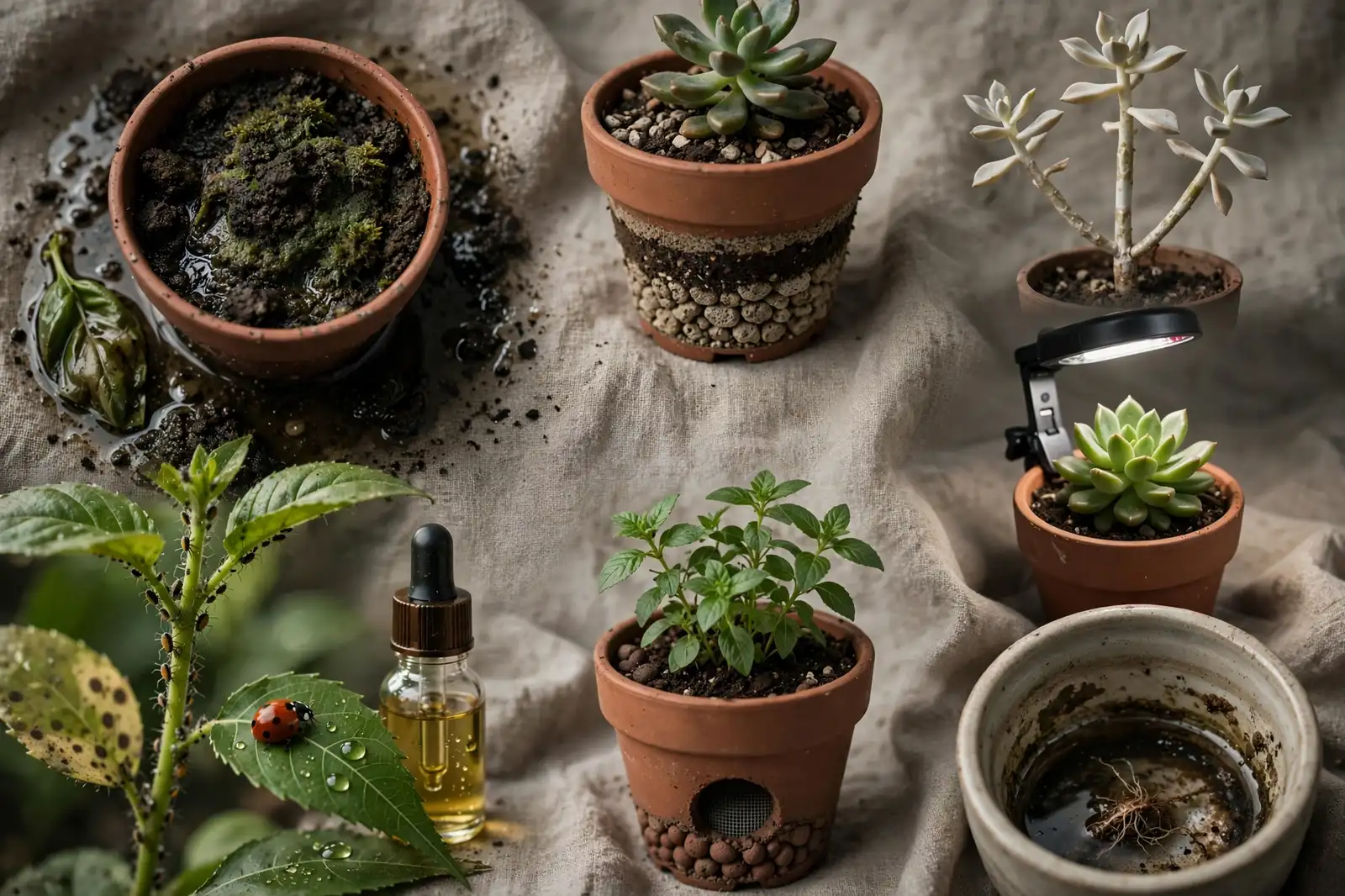
7 Common Mistakes in Apartment Gardening and How to Avoid Them
Published on 7 min readHome and GardenCompare AI models
The biggest mistakes that ruin an apartment garden are using small pots, overwatering, and neglecting light needs. These issues can leave plants weak or dead in weeks if not addressed. Fix them by observing your plants, testing soil moisture with your finger, and ensuring at least three hours of direct light daily for most vegetables.
How to tell if your pots are too small for apartment gardening?
A suitable pot has enough space for the plant's roots to spread and absorb water without being cramped. You'll know the pot is too small when roots start growing out of the drainage holes or form a dense tangle at the bottom of the pot. This happens because the plant has no more room to grow.
A tangled root system blocks nutrient absorption, and the plant shows stress signs like yellow leaves and stunted growth. I experienced this with my lettuce—roots formed a tight ball, and leaves turned pale. To fix it, transplant the plant into a pot at least a third larger. A 2-liter pot becomes 3 liters, and a 5-liter becomes 7 liters. Gently remove the plant, loosen the roots slightly from the root ball, and place it in the new pot with fresh soil. Don't press the soil too tightly around it. To learn more, read How to choose the right pots for apartment gardening without mistakes?.
It's a common mistake to keep a plant in the same pot indefinitely. Most vegetables need more space every two to three months. I had a cherry tomato plant that stopped growing for six weeks; when I removed it from the pot, roots filled the entire space.
How to know if you're overwatering your apartment plants?
Overwatering occurs when you add more water than the soil and roots can absorb, leaving the soil soggy for days. The main symptom is yellow, soft, almost translucent leaves and a sour smell from the soil. Roots rot without oxygen.

I made this mistake with my cherry tomato plants, watering them daily because I thought they were dry. In a week, lower leaves turned yellow and fell off. I learned the best way to avoid this is the finger test: stick your index finger up to the first knuckle (about 2 centimeters deep). If your finger feels moist, don't water. Only water when the soil is dry at that depth.
Another method is using a wooden stick, like a skewer. Push it into the soil, wait a few seconds, and pull it out. If it comes out clean and dry, it's time to water. If it comes out with wet soil stuck to it, wait another day. In summer, this might be every two days; in winter, it could take a week.
How to choose a spot with enough light for your apartment garden?
Sufficient light is the amount of direct or indirect sunlight a plant needs for photosynthesis and growth. Needs vary: herbs like mint and tomatoes need 5-6 hours of direct sun; lettuce and spinach tolerate bright indirect light.
To choose a spot, observe your windows all day. Note how many hours of direct sun each gets and when. Most productive plants need at least three hours of full sun. North-facing windows (in the southern hemisphere) usually get less direct light.
I tested all the windows in my apartment. The east-facing window, which gets sun from 7 AM to 11 AM, was great for basil and chives. The south-facing window, with strong afternoon sun from 2 PM to 6 PM, burned the tips of my arugula in two days. If you don't have such a window, you can supplement with full-spectrum artificial light, but it needs to be on for 12-16 hours daily, which increases your electricity bill.
Placing a plant where you think it looks nice, far from the window, is a common mistake. Without light, it becomes leggy and weak. My first basil plant grew 30 centimeters tall with only four thin leaves.
How to prepare soil for apartment gardening without mistakes?
A suitable potting soil drains well but retains moisture and nutrients. The classic mix is one part garden soil, one part worm castings, and one part coarse sand. Sand is critical for drainage—without it, the soil becomes compacted.
To prepare, mix the three ingredients in a bucket until evenly combined. For a medium 5-liter pot, use 1.5 liters of each component. Worm castings provide nutrients for the first 4-6 weeks of growth. I once used only regular garden soil, and my basil seeds barely germinated. When I switched to this mix, seedlings grew vigorously in a few days.
Always use sterilized soil, either bought pre-sterilized or treated at home. Unsterilized soil can bring insect eggs or fungi. You can sterilize homemade soil by spreading it on a baking sheet and baking it at 180°C for 30 minutes. Let it cool completely before using.
How to start an apartment garden with no prior experience?
Step-by-step guide
- Choose easy plants. Herbs like mint, basil, and chives are most tolerant of beginner mistakes. Avoid starting with peppers or eggplants, which are more demanding.
- Use pots with drainage holes. Pots without drainage are a trap—water accumulates at the bottom and rots roots. A saucer underneath is useful, but empty excess water that drains after watering.
- Prepare the soil mix. Don't use pure garden soil. Follow the recipe: one part soil, one part worm castings, one part sand.
- Place pots in a sunny spot. Put them by the window with the most sun. If you don't have one, prioritize shade-tolerant plants like spinach and some leafy greens.
- Water with care. There's no set schedule. Only water when the finger or stick test shows the soil is dry at the surface.
I recommend starting with a mint seedling in a 2-liter pot. Buy a young plant to skip the delicate germination phase and see results in a week.
What are the most difficult common mistakes in apartment gardening to fix?
The hardest mistake to reverse is an established pest infestation, like aphids or mites. They spread quickly between nearby pots. Signs include chewed leaves, brown spots, or a fine web, plus visible insects on the undersides of leaves.

To try and fix it, immediately isolate the plant and wash the leaves with a solution of water and mild soap—one tablespoon of soap per liter of water. In my experience, if the infestation is visible on multiple leaves, this control rarely works 100%. Often, it's safer to discard the infested plant to protect the rest of the garden. Prevention is best: inspect plants regularly, especially under leaves, every three to four days.
Another tricky problem is chronic nutrient deficiency from using poor soil for months. Leaves turn yellow starting from the veins, and the plant stops growing. Adding fresh worm castings can help, but the most reliable solution is transplanting into fresh, nutrient-rich soil.
What alternatives are there for apartment gardening if you don't have enough light?
If your window gets little direct light, you have two main options. The table below compares them:
| Criterion | Artificial light | Shade plants |
|---|---|---|
| Initial cost | High (cost of light bulb and timer) | Low (just pot and soil) |
| Maintenance | Moderate (needs to be turned on/off and bulbs replaced) | Low (only watering and occasional fertilizing) |
| Plant type | Almost any (depends on light bulb power) | Only adapted species (e.g., spinach, some lettuce types, basil) |
A concrete example is spinach, which grows well with bright indirect light. You can get a good harvest on a windowsill that doesn't get direct sun. If you choose artificial light, use a full-spectrum grow light positioned 20-30 centimeters above the plants, on for 12-16 hours daily.
The next concrete step is to pick just one easy herb or leafy green and set up your first pot today, following basic drainage and soil steps. With one working pot, you'll gain confidence to expand.
*This text is for informational purposes only and does not replace professional horticultural or agronomic advice.*
Read also
Frequently asked questions
Can I grow bell peppers in an apartment with low light?
You can cultivate pimentão in an apartment with pouca luz using luz artificial. Pimentão precisa de luz direta por pelo menos seis horas por dia. Luz artificial pode substituir a luz solar se usada por esse período
How long does it take to harvest herbs grown in an apartment?
O tempo de colheita de ervas cultivadas em apartamento varia conforme a espécie. Manjericão leva cerca de 30 dias para estar pronta para colheita. Você pode colher as folhas quando a planta tiver pelo menos seis folhas
Can I reuse soil from old pots for my apartment garden?
Você pode reutilizar o solo de vasos antigos se ele for limpo e rico em nutrientes. É importante esterilizar o solo para evitar pragas. Adicione húmus para renovar os nutrientes